

GMDN

Blog - Is the GMDN a useful tool to analyse adverse incident data?

22 July 2026

Is the GMDN a useful tool to analyse adverse incident data?

Blog – by Dr. Barry Daniels, Senior Clinical Lead at the GMDN Agency

To investigate whether the GMDN could be a useful tool in analysing adverse incident data, we firstly downloaded the publicly accessible US FDA 2025 Manufacturer and User Facility Device Experience (MAUDE) data.

There were 2.88 million records and to carry out the analysis we filtered out the records which have a UDI field completed, which numbered 1.9 million records, leaving nearly 900,000 records for us to analyse.

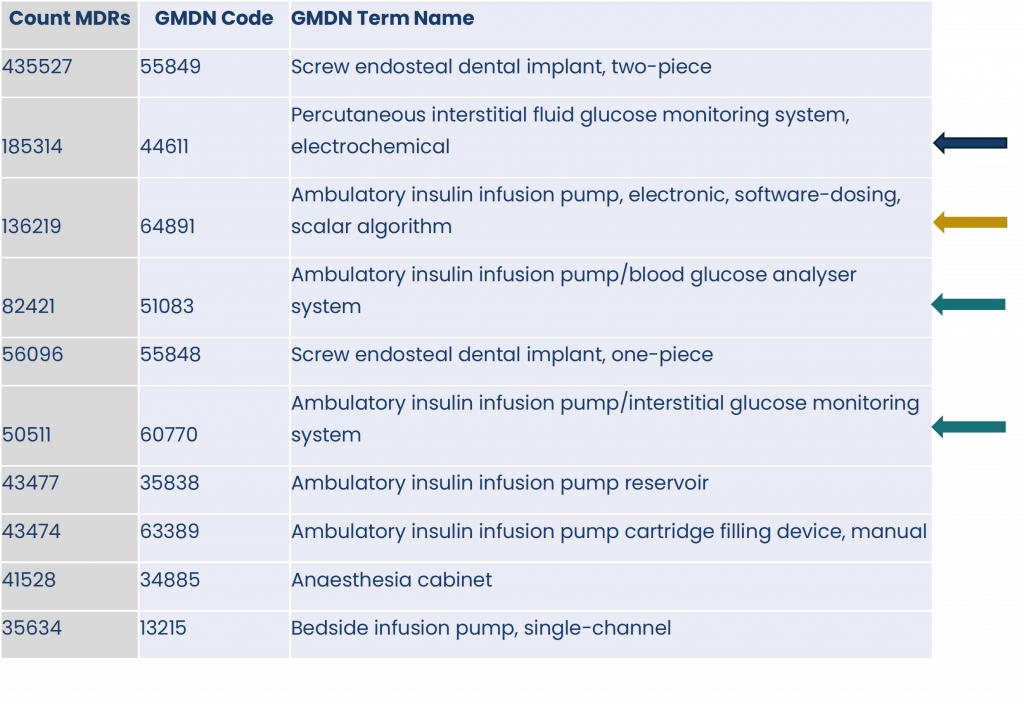
By cross referencing this data with the full GUDID data, the corresponding GMDN Term for each record was identified. The number of adverse incidents (MDRs) for the top ten occurrences by GMDN Term is in the following table:


Glucose monitoring 

 Insulin pump plus blood glucose or interstitial glucose monitoring  

Insulin pump only 


DEVICE FUNCTION

Catheterization/Cannulation/Fluid path devices CT2818

   Fluid infusion/injection devices CT2822

      Infusion pumps and associated devices CT268

         Infusion pumps CT1821

            Non implantable infusion/syringe pumps CT111

               Ambulatory insulin infusion pumps CT1822 


The GMDN Terms in this Category are:
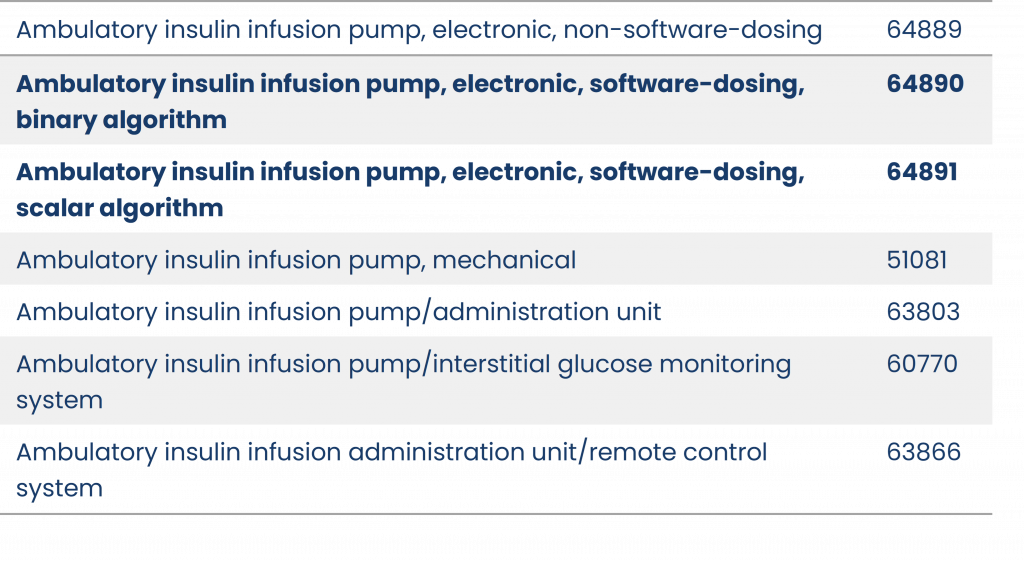
Note the difference in MDR count for the two related GMDNs:

Ambulatory insulin infusion pump, electronic, software-dosing, scalar algorithm –   136219

Ambulatory insulin infusion pump, electronic, software-dosing, binary algorithm – 763

There is clearly a significant increase in incidents for pumps using a scalar algorithm, which would certainly not have been obvious without using the analysis based on GMDN Term assignment and allows further investigation into the products that can be identified by the GMDN.

Indeed, it was found that a particular product (that we cannot name explicitly here) was identified as associated with the vast majority of the MDRs.

Looking further it was found that that particular product is recorded with multiple UDIs which would further hinder identification if not associated with the same GMDN Term.

The analysis suggests that GMDN is valuable for grouping devices at both Term and Category level, enabling comparison between similar device types and supporting signal detection. It can also help identify products recorded under multiple UDIs, where those products share the same GMDN Term. This highlights the importance of including UDI information in adverse incident data and assigning GMDN Terms accurately.

We are happy to share further details, including product-level data, with national regulators interested in learning more.