How Does a New Medical Device Get Its GMDN Term?
12 November 2026
Behind the Terminology that provides a common language for medical devices
by Graham Nash, Health Data Strategy Lead at the GMDNAgency
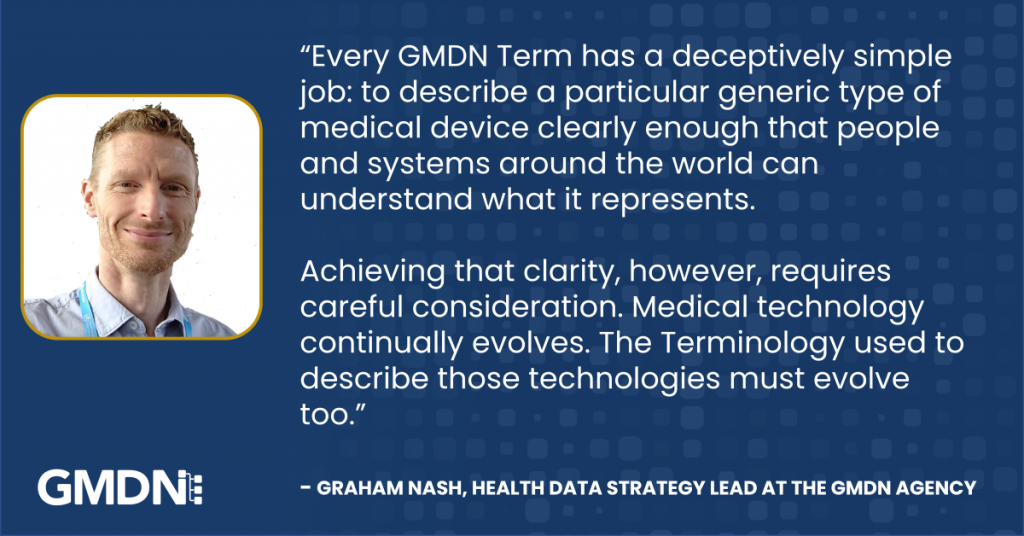
Every GMDN Term has a deceptively simple job: to describe a particular generic type of medical device clearly enough that people and systems around the world can understand what it represents.
Achieving that clarity, however, requires careful consideration.
Medical technology continually evolves. Manufacturers develop new products, established technologies change and entirely new categories of device emerge.
The Terminology used to describe those technologies must evolve too.
So, what happens when an existing GMDN Term no longer fits, or a genuinely new type of medical device needs to be described?
More than naming a product
One of the most important principles behind GMDN is that it describes generic device types, rather than individual brands or manufacturers’ products.
That means developing Terminology is not simply a matter of copying the commercial description given to a new device.
A device may have a highly specific product name, but the Terminology needs to capture the characteristics that distinguish the generic device type in a way that is useful beyond a single manufacturer.
This distinction helps keep the Terminology independent and consistently applicable across the medical device community.
Understanding the device
Before an appropriate Term can be established, it is necessary to understand the device itself.
What is it intended to do?
What characteristics distinguish it from similar technologies?
Does an existing GMDN Term already describe the device appropriately?
These questions matter because creating unnecessary Terminology can introduce duplication and ambiguity rather than clarity.
Sometimes an apparently new technology can already be appropriately represented within the existing GMDN nomenclature.
In other cases, technological development means that something genuinely different needs to be considered.
Finding the right level of detail
There is another challenge too: specificity.
A Term that is too broad may fail to distinguish meaningfully between different types of device. One that is excessively narrow could introduce unnecessary complexity.
The aim is Terminology that communicates meaningful differences between generic device types while remaining clear and usable.
Definitions are consequently important.
A GMDN Term is not simply a name or label. Its definition helps establish what the Term represents and, just as importantly, distinguish it from other Terminology that may initially appear similar.
An evolving language
Individual additions and changes form part of a much bigger task: maintaining a coherent global nomenclature.
Medical technology changes quickly. Language changes. New fields emerge and established technologies develop new applications.
The Terminology therefore cannot remain static.
At the same time, change has to be considered carefully. GMDN is used internationally, so maintaining consistency and clarity across the Terminology is fundamental to its value.
This makes Terminology development a continuing process rather than a finished project.
Why it matters
To somebody searching the GMDN database, a Term may look like a relatively small piece of information.
Its potential importance becomes clearer when viewed as part of a much larger ecosystem.
Manufacturers, regulators, healthcare organisations and other stakeholders may all need to describe medical devices within their own systems and processes. When they use a common nomenclature, information can be communicated more consistently across organisational and geographical boundaries.
Behind every GMDN Term, therefore, is a wider objective: helping the global medical device community speak the same language.
And as medical technology continues to develop, maintaining that common language means ensuring the Terminology develops with it.