
When is a Medical Device not a Medical Device?
28 April 2026
When is a Medical Device not a Medical Device?
By Graham Nash, Health Data Strategy Lead at the GMDN Agency
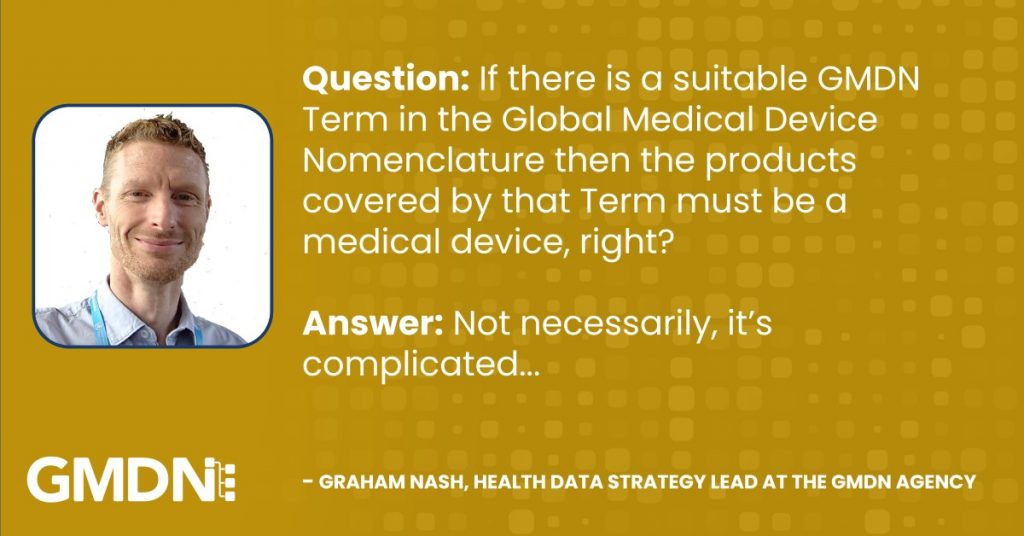
Question: If there is a suitable GMDN Term in the Global Medical Device Nomenclature then the products covered by that Term must be a medical device, right?
Answer: Not necessarily, it’s complicated…
The term MEDICAL DEVICE can be defined as:
instrument, apparatus, implement, machine, appliance, implant, reagent for in vitro use, software, material or other similar or related article, intended by the manufacturer to be used, alone or in combination, for human beings, for one or more of the specific medical purpose(s) of:
— diagnosis, prevention, monitoring, treatment or alleviation of disease;
— diagnosis, monitoring, treatment, alleviation of or compensation for an injury;
— investigation, replacement, modification, or support of the anatomy or of a physiological process;
— supporting or sustaining life;
— control of conception;
— disinfection of medical devices;
— providing information by means of in vitro examination of specimens derived from the human body;
and does not achieve its primary intended action by pharmacological, immunological or metabolic means, in or on the human body, but which may be assisted in its intended function by such means
[ISO 13485:2016]
Different jurisdictions often have variations in their definition of Medical Device. Those differences will tend move the boundary or borderline between being a regulated medical device and a non-medical product. Sometimes that borderline makes something fit the definition of a medicine, sometimes it makes it fall into other regulations. In some cases, the definition has been specifically drafted to bring a particular type of product in or out of scope of the definition because of a perceived gap or ambiguity in other definitions.
Often there are overlapping regulations related to product safety including the presence of chemicals or the use of powered machinery which will apply even if a product is a medical device.
Even where the definition is the same in different jurisdictions, the regulatory authorities may have different interpretations of the definition and any guidance related to it. It is also possible that the interpretation can evolve over time and one regulatory authority might review a decision so that a product which was previously not considered to be a medical device is subsequently ruled to fall within the definition.
Regulatory authorities tend to base their decision on the claims the manufacturer makes about their product – the intended purpose and the way that purpose is achieved. Different manufacturers might describe things in different ways meaning that apparently similar products might have significantly different claims.
A toothbrush can be thought of as a general hygiene product, or it can be described as a way of reducing or removing bacteria to preventing dental caries (cavities). So, a toothbrush can be a medical device, which can mean that toothpaste is an accessory to the toothbrush and is also a medical device.
A massage chair might be a pleasant way to relax, but that could be described as providing symptomatic relief from muscle and joint pain and aiding their recovery and healing after exertion and/or injury.
Of course, there is also software, particularly AI or machine learning which is currently a hot-topic. The line between an administrative tool and a medical device which makes or informs a diagnosis, or can recommend or even provide treatment, might even move after a product is supplied.
The GMDN Agency uses the intended purpose and instructions for use and other information about a product to decide whether a current GMDN Term can be correctly assigned to the product without amendment or if an edit is needed to enable correct assignment, or if a new GMDN Term is needed.
The GMDN Agency does not decide or interpretate about whether a product is considered to be a medical device or not. There are certainly some GMDN Terms that will be regulated as medical devices in some jurisdictions and not in others. There are probably some terms which are not considered to be medical devices in any jurisdiction. That doesn’t matter – the GMDN Terms are available to regulators and other stakeholders across the healthcare system to use in a range of ways.
It is important to add to and refine the nomenclature to ensure it is up to date and includes new innovations and adapts to changing priorities. If there are medical devices which don’t have a GMDN Term, then that will cause a problem – that’s why we have an enquiry process to enable us to respond to developments in the industry and keep the nomenclature up-to-date and as useful as possible.